The copy-paste tax: what manual data entry really costs you
Every retyped invoice, every copied address, every field entered twice has a price. Here's the math — including the error cost nobody puts on a spreadsheet.
5 min readBy Nick Hayghe
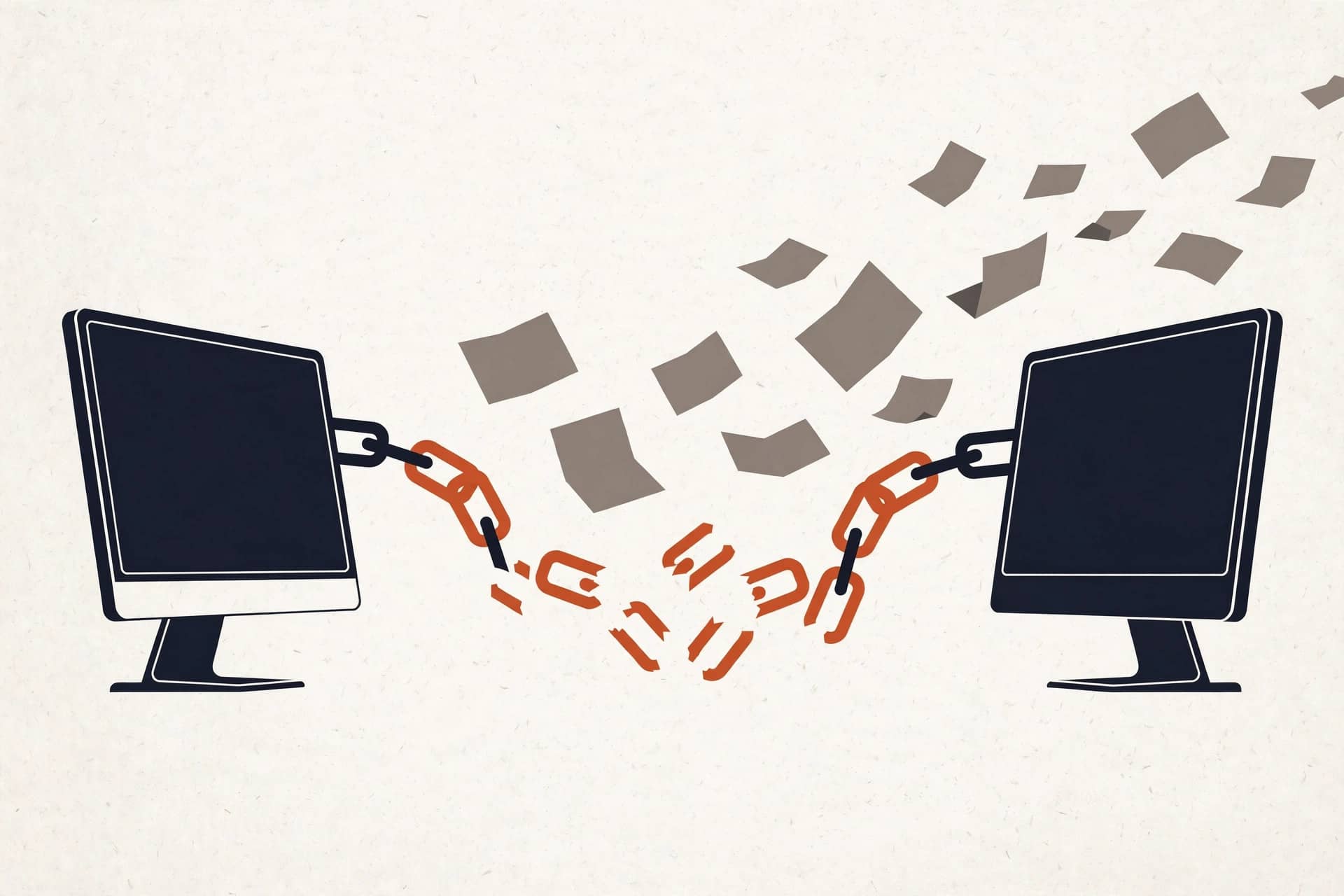
This is a companion to the bigger guide — Your tools, finally working together: the integration playbook. That post lays out the full approach. This one is about the pain that makes the approach worth doing: the copy-paste tax.
No hype in this post. Just arithmetic.
The retype math
Pick a number from your own week. How many records does somebody retype between apps — invoices, customer details, job info, addresses? Let's say it's 12 a day, at 3 minutes each. That's conservative; we've watched people spend longer on a single invoice.
12 records × 3 minutes = 36 minutes a day. That's 3 hours a week. That's 156 hours a year.
Now put a price on it. Say the person doing it costs you $35/hr fully loaded — wages, taxes, benefits, the real number. 156 hours × $35 = $5,460 a year.
Per person. Doing work that creates nothing.
And that's one retyping habit. Most businesses have three or four: the CRM-to-accounting shuffle, the form-to-spreadsheet shuffle, the email-to-calendar shuffle. Add them up and you're paying a full-time salary's worth of copy-paste across the team.
invoice: typed in app A ✗ typed again in app B ✗ nobody's job description mentions it ✗
The error cost nobody counts
Here's the part that never makes it onto a spreadsheet: humans mistype. Not often — just often enough.
A transposed digit in an invoice total, and you're making an awkward phone call to a customer. The wrong address on a work order, and your tech drives to the wrong side of town — that's a wasted truck roll, fuel, and an hour of a skilled person's day. A phone number copied wrong, and your follow-up call goes to a stranger.
None of these show up as "data entry cost." They show up as fuel, as rework, as the customer who quietly goes with someone else because the first visit was a mess. You can't put a clean number on it, but every owner reading this has a story. Ask your team for theirs — they'll have three.
Computers copy perfectly. That's the whole argument. Not faster — perfectly. Every time.
Why it keeps happening
If the tax is this obvious, why does everyone keep paying it? Three reasons:
- It's invisible. Nobody logs "retyping" on a timesheet. It hides inside "admin" and "catching up."
- It feels small. Three minutes here, five minutes there. Nobody notices the minutes; everybody would notice the $5,460.
- The fix feels technical. "Integration" sounds like an IT project. It isn't — it's plumbing, and most of it is configuration, not code.
That's also why the people doing the retyping rarely complain about it. They assume it's just part of the job. It isn't. It's a wiring problem wearing a job description.
You're not paying for software. You're paying people to be the software.
Where the tax hides in your business
The copy-paste tax doesn't show up as a line item. It hides inside ordinary days. Here's where we find it most often:
| The retyping | The apps involved | The quiet cost |
|---|---|---|
| Customer details | CRM → accounting | Duplicates, wrong billing addresses |
| Job notes | Email → scheduler | Techs arrive uninformed |
| Lead info | Web form → CRM | Slow follow-up, lost leads |
| Invoices | Accounting → job records | Nobody knows what's paid |
| Hours | Timesheet → payroll | Payroll errors, corrections |
Walk your own week through that table. For each row, ask: who does this, and how many minutes does it take? Multiply by 50 weeks. That's your tax bill — and unlike your real taxes, you can legally make this one go away.
The mistakes have names
The error cost deserves one more look, because "human error" sounds abstract until it has a name. Call them what they are:
- The wrong-address dispatch. A tech drives 40 minutes to the old address because the work order was retyped from an email. Fuel, time, and a customer who watched the clock.
- The transposed total. $1,540 becomes $1,450 on the retyped invoice. Somebody eats the $90, or somebody makes the awkward call. Either way it costs more than $90.
- The lost follow-up. The note about the customer's budget lived in the email, not the CRM. The quote goes out wrong. The deal stalls.
Each one is a small story. Add up a year's worth of small stories and you get a number nobody wants to say out loud. The pipe doesn't just save the retyping time — it deletes the entire category of mistake.
The fix is boring on purpose
There's no clever trick here, and that's the point. You list the retyping, you build the pipe, the retyping stops. The most valuable automations in a small business are the dull ones — the ones nobody demos at conferences, because "customer address now appears in both systems" doesn't get applause.
But it gets you 156 hours a year back. Boring is profitable.
The reframe
You're not paying for software. You're paying people to be the software.
Every app you bought promised to save time. But the gaps between them are filled with human labor — your labor, your team's labor, at $35 an hour, copying fields a pipe could move in a second. The apps aren't the problem. The gaps are.
That's not a staffing problem. It's a wiring problem. And wiring problems have fixed prices and payback periods you can put on paper.
Get a free tool-stack audit
We'll find every place your team retypes data, run the math with your real numbers, and show you what the fix costs. If it doesn't pay for itself, we'll tell you not to build it. Book a free tool-stack audit